Feb 6, 2013

#5 THE BLACK DEATH!!! (1300 - 1400 c.e.)


Poor Western Civilization.
"Who? Us?"

There they were, eating food, weaving on horizontal looms, going on crusades, and making up rules about what people could wear when BAM!

the Bubonic Plague
That's right, the Black Death,which it's called cause it made the skin rot and turn black in places.
Like this

They think it started on rats in China, made it's way through Constantinople (which is now Istanbul) by way of rats, and eventually rode trade ships (and the backs of rats) all the way through all of Europe.
Rats!

So that was a bummer.  No one knows for sure how many people died but it was a lot.  Wikipedia says somewhere between 75 million and 200 million people.  MILLION.

With that many dead friends/neighbors/family members, EVERYONE
had to pitch in and carry caskets.
Folks didn't know how this massive pandemic started so there were all sorts of things they tried.  They thought perhaps that miasmas (fog) caused it so everyone avoided bad air.  They burned fires and sniffed herbs.  They asked the Pope to ask God to slow the disease 
"Please?"
but he was busy sitting between two giant fires himself to try to keep the disease away.  

This is what a doctor would wear when visiting plague victims.
the nose of the mask is full of herbs which allegedly kept the disease at bay.
He also carried the stick because he wasn't about to touch anyone or
anything with his hands.
I guess looking super creepy was just a bonus.

People, when faced with an environment where EVERYONE IS DYING
Like this
start looking for somewhere to place the blame.   Some devout Catholics decided that God was punishing all of them so in an attempt to appease this vengeful God, they started walking around barefoot and hitting themselves with whips.
Good times.

Oddly, self-mutilation failed to halt the spread of the bacteria.   Folks then tried witches and amulets and lucky charms and basically anything they could think of.
Which you would do, too, if your kid got sick
Some people actually decided that Jewish people were the reason they had the disease and started killing Jews.
Because when things are awful, the best thing to do is make everything awfuler.
Why do I bring this up?  Well, because it changed just about everything in Europe.  If 40-70% of the people in any given place are dead, then who is going to grow the food?  Which, by the way, didn't want to grow because right after the plague slowed down, The Little Ice Age began.

"This is the worst century EVER"
There was famine, low population, cold, and misery.   Naturally, there was war, and a lot of it, because all the infrastructure was messed up (again.)  Oddly, all of this horribleness was important in the development of the coming Renaissance but it sure was rotten to live through.

What does this mean for fashion?  Well, for women, the ideal silhouette was to look pregnant.

"Do we look pregnant enough?"

Since the women were still wearing the kirtle (or smock, or chemise, or dress) they enhanced this "I-totally-am-fertile-look-at-my-pretend-baby-bump" look by belting their dresses right up under the bustline and standing like supermodels, pelvis out.

"You, milady, are looking foxy in that maternity dress!"
Why would they do this?  Well, the official excuse is they all aspired to be like the Virgin Mary, and reflect the holy pregnancy in their own fashion.  More probably this fashion happened because everyone was DEAD and folks needed to start making some BABIES!

Also, during this time period, an unfortunate thing began happening in menswear.
"Does your mom know you walk around in a skirt that short?"

The waist line of men's tunics was dropped to the hips to make the body look longer. (Kind of like it is today.)  Well, obviously, the skirts had to be shorter so they wouldn't look dumpy and eventually the skirt of the tunic was as short as you see it above. The problem with that is the hose the men would wear didn't have... um.. crotches in them.  When you're wearing tights you can't wear boxers under them.  They would be all bunchy.  So, each leg was a single tube and they tied at the top to a belt at the waist, leaving the middle open.  All the time.

If your skirt is that short, you are wearing crotchless pants, and it's COLD, something has to be done.  (Well, something other than accidentally flashing people all the time.)What was done was this:
This is the least offensive picture I could find.
It's still pretty offensive.
A triangular bit of fabric was pinned or buttoned to the front of the two legs of the hose and helped prevent immodesty.  It's called a codpiece.  For the most part it was hidden under the skirt of the tunic but (ominous foreshadowing) it wouldn't stay hidden for long. (dum dum DUMMM) More on this next week.  

However, another bit of fashion was invented in the deathly cold 14th century.  The houppeland!

The dude in pink is wearing a houppelande

It's basically a ginormous bathrobe with super long sleeves that are pinked (cut with fancy edges).  Women wore them too.
"Aw, yeah, we be rocking us some houppelands."
Of  course people were appalled at the outrageous waste of fabric and criticized them.  You will not be surprised to learn that this criticism stopped exactly nobody.

So, that's some brief information about the Late Middle Ages, which are also known as the Middle Gothic Period.
wrong kind of gothic...
Thaat's better...
It was a terrible time in Western history but at least the women stopped wearing those pointy princess hats.
"Obviously you are intimidated by my glamour.."
Now, go take your test!

Jan 30, 2013

#4 High Middle Ages (1000 - 1300 c.e.)

Women hunting deer in dresses. Like you do.


Hello friends!  Welcome to the High Middle Ages!  The weather was nice!  People started having babies!  Folks started clearing land!  Governments stabilized!  Universities were formed!  Spain was called Al-Andalus, Germany was known as the Holy Roman Empire (though neither holy, Roman, or an empire), and all the Scandinavians were now Christian.


Generally speaking, it wasn't a bad time to be alive.  Sure, there were a few crusades, war and death, but there was FOOD.  And, usually, not starving to death makes folks more cheerful.  Also, when there's plenty of excess food, your community can do things like let artists paint and sculptors sculpt and scholars study.  And, important to fashion development, it let inventors make stuff. Cool stuff.   Fashion stuff.

 Before, everyone had always woven fabric on vertical looms.  Like this:

You begin to see why they never wanted to cut the fabric.

But, some clever woman or man figured out how to make horizontal looms with foot shuttles.
This, as you might imagine, GREATLY improved the speed and quality of fabric available.

Oh, and I forgot to mention the conversion from distaffs:

Which, admittedly, looks pretty glamorous..

to spinning wheels.


Sure, spinning wheels are far less relaxing than distaffs, but the quantity and quality of thread which could be spun was massively improved.  Which means it was possible, if you were rich, to have really NICE clothes, clothes which were brightly colored and felt good, clothes which you got to impress the neighbors with.  Clothes which looked like this:


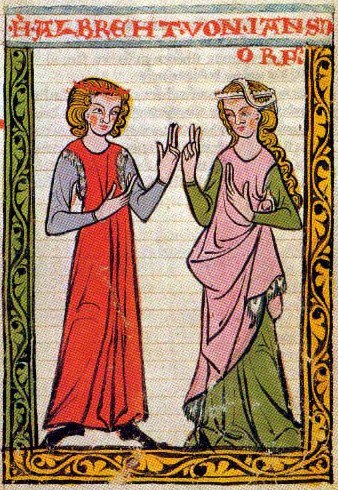
Quick! Look at their faces and tell me which one is the girl.

Hard to say, right?  Well, I found this quote:

"Men’s clothes were generally shorter, but the body shape that the clothes emphasized, and also partially created, was the same. In addition, the beauty ideal appears to be virtually identical for both sexes, something that also can be seen in mediaeval literature where a young man frequently is mistaken for a young woman. This confusion is possible because the concept of human beauty was the same irrespective of sex; a beautiful young man was expected to look the same as a beautiful young woman.

 This can be tied to what historian Thomas Laqueur termed “the one-sex model” or “the Aristotelian model”. This is the medical and scientific view of sex as a difference in degree of development and not as a difference in nature. The degree of masculinity and femininity was determined by the balance of the different humours that were thought to govern the body. According to this view, that which today is seen as primary and stable, biological sex, was seen as mutable. The basis for what was perceived as masculine and feminine was instead men’s and women’s social roles and the hierarchy between them. This was also the starting point when the body was interpreted; woman was not inferior to man because her body was weaker, but her body was weaker because she was inferior to him. 

  This fact explains several phenomena in mediaeval dress. That the cut and appearance of most garments were largely identical is a natural consequence of a common ideal of appearance and beauty for both men and women, based on the one-sex model. It also explains much of the critique directed at fashionable dress. When it was branded as indecent that a woman wore a belt on her hips, as happened in the second half of the fourteenth century, it had nothing to do with exposure of or emphasizing of sexed body parts, or with sexuality. Instead it was the symbolic value of a belt worn at the hips, the traditional placement of the sword-belt, with its implications of knighthood and masculinity that made it unseemly for a woman.

Source: Developments in dress history” at Brighton University December 8th-10th 2011
Eva I Andersson PhD


Q: Is this a man and two women, three women, or three men? A: Yes!

Crazy, right?

Anyway, the guys who worked in the field still wore the same stuff they had pretty much always worn since forever:
"I've been workin on the wheat farm, all the live long day.."
This means a tunic, leggings, and some linen underpants. Though, these items might also be called a blouse, trousers, and braies.  Peasant women wore an undertunic (or chemise, or chainse, or smock) made of linen, and then one or more ankle-length tunics (or gowns or kirtles.)
"Peace out, homies!"

Later on women started wearing surcoats.
I'm including this medieval glamour shot cause I think it's kind of funny.
Surcoats were basically long tunics with no sleeves.  Eventually men started wearing them, too.
Hawt
 So, what's different about this stuff compared to the Dark Ages?  Well, the hats are new, right?

"What about our hats?"


"You mean these old things?"


Pretty exciting, huh? Well, not only are the hats kind of ridiculous, they tell everyone looking at them that the wearer of such a hat is IMPORTANT!!!

The High Middle Ages was when Sumptuory Laws were first invented.  These laws, passed by kings and lords, basically said that only certain (rich or noble) people could wear certain kinds of fabric (silk, gold, brocade, velvet) or certain colors (purple, red, gold.)  
This is brocade.  The idea of weaving this WITHOUT a horizontal
loom makes me want to cry.
There were also rules about how married women did their hair vs unmarried women, and what court officials wore vs what rich tradesmen could wear, and even what color cloak scholars could wear.  (Red. Scholars wore red.)  There were even rules about how short a man's tunic could be, with only noblemen allowed to have a tunic so short it showed his bottom.  The crusades happened at this time, which means stuff like turbans and silks came to Europe.  Obviously there had to be rules because if everyone was in a turban then chaos would ensue, right?  (Oh, and watch this video about the crusades because it's super cool:    http://youtu.be/X0zudTQelzI )

Really, what this means is, no matter where you were or what you were doing, EVERYONE knew EXACTLY who you were JUST by the clothes on your body.

"Just me, a rich unmarried woman, hanging out with my two math teachers
and a couple of guards being watched by a crowd of creepy praying guys."

Kinda interesting, huh?  But, they also had to invent sumptuory laws because something else was invented in the high middle ages, and it's the reason we are here.  

That's right.  They invented FASHION.

"Because we are FABULOUS!"
 Now, fashion in the high mids didn't change every few months or every few years, like it does now.  Clothing still took a long time to make.  Fashion, instead changed every generation.  That's right, the kids didn't want to look like their parents, so they changed stuff.

Sleeves got really long.
"You kids today with your long sleeves and uncovered hair...!"
Dresses got tight in the waist.
"You kids today with your long sleeves and tight dresses...!"
And, some unmarried girls even went so far as to wear ONLY ONE TUNIC.

"You knew I looked scandalous, you just didn't know why.."
For men, the skirts just kept getting shorter


and shorter with fancy socks


until eventually, the mens' hemlines were back at Greek levels of naked. (Though, they were totally wearing tights  underneath so maybe it wasn't AS naked.)
"Hey baby..."

And, yes, you caught me.   I cheated with the above picture because it's a fashion from the 1400s, which is later than what we are discussing today.  However, it shows the evolution.

You may also have noticed the lack of cross gartering.  This is because folks figured out how to keep their socks up by tying them to their underwear.
I totally wasn't kidding.

Amazing.

I believe that's enough for now about the High Middle Ages, a time of food and plenty, war and strife, and some fabulous new inventions.  Now go take your test!


Jan 23, 2013

#3 The Dark Ages (or The Early Middle Ages) 400 - 900 a.d.

"So, is everything dark because
 it's the dark ages?..."


So, Rome was sacked in 401 or 410 A.D. by the Visigoths.   The Roman Empire continued to exist because there was a second capital in Bysantium, but for Europeans, (and therefore Western Civilization) the idea of massive centralized government was a thing of the past.  And, just like in 3 Nephi 7, society devolved into tribes.  Cities fell, roads were haunted by robbers and highwaymen, and the basic infrastructure which keeps civilization mostly civil dissapeared.  There were wars and famine and plagues.  Cities were so dangerous, the rich folks moved to rural villas, taking their own private armies, slaves, families, and craftsmen with them.


"We're rich!"
Out of these estates, and the rich folks living in them, the feudal system evolved.   But, it was literally a few hundred years until that happened.  Because of the chaos and illness and bad stuff, there are very few records of the clothing folks wore in Europe at this time.  And by "time" I mean from 400 a.d. to at least 900 a.d.  Most of the clothing, however, was still pretty Roman.  Ya see, the folks up in northern Europe had started wearing those tunics, like the Romans did, but since northern Europe is seriously COLD, they added sleeves. They also wore leggings.  Or, they wore leg bandages, which is exactly what it sounds like, and probably just as miserable.


"Why wear shoes when I'v got
 perfectly good strips of wool to wrap around my feet?

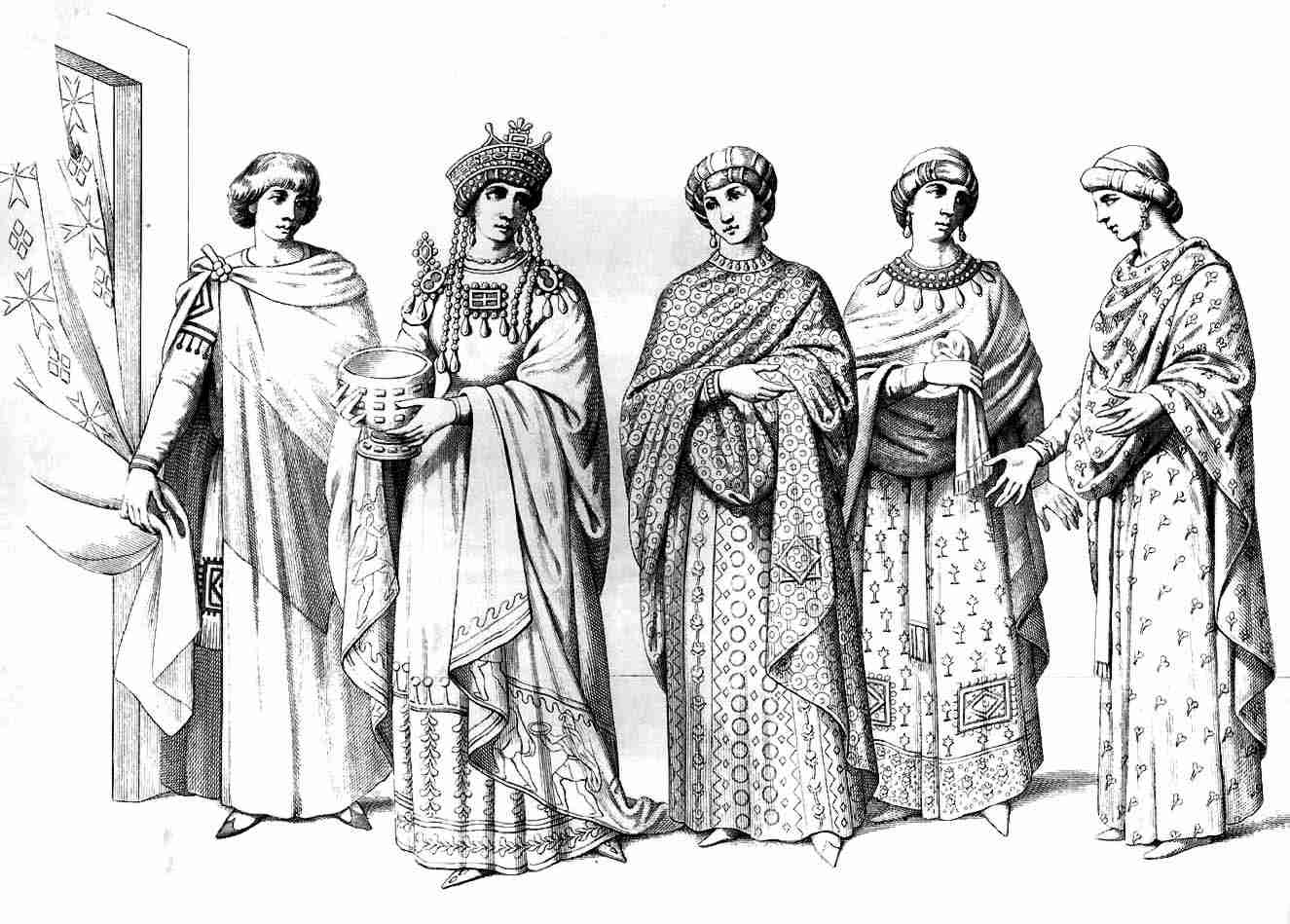
If you will notice, the Frankish gentleman above has on a striped tunic which looks suspiciously Roman, right?  You see, if you identified yourself as a Roman, you kept the same sort of style as a Roman.  Specially since Bysantium (which was next Constantinople and is now Istanbul) was doing stuff like this:
"It's FABULOUS here!"
"And so are we!"


"Word."


The Eastern Roman Empire was still orderly and had scholars of many religions and countries learning lovely things and building lovely things and was, generally speaking, not so bad.  Being Romanish and wearing Roman-inspired clothing continued to be the cool thing, though we added more color and patterns and gold and cool hats and stuff.

But, if you were northern European, Rome was a fashion influence but you could also do your own thing.  These Anglo-Saxons were pretty Roman:

"Yes, we are!"

As are these nice Frankish noble people.


These Vikings throw their own twist on the look:

Not a single warrior ever wore a helmet decorated with cow horns.  It's stupid to give someone
a giant hook to grab your head with and is a made-up thing added to drawings of Vikings later in history.

Please look at the Viking man's legs.  This is called cross-gartering and in a time when NOTHING was stretchy, it was the one of the only ways to make your clothing tight and flexable at the same time.  Basically you would just wrap lengths of leather or fabric around your legs to keep your pants tight.   Needles at this point were still made of bone and not super strong so tailoring is still pretty minimal.

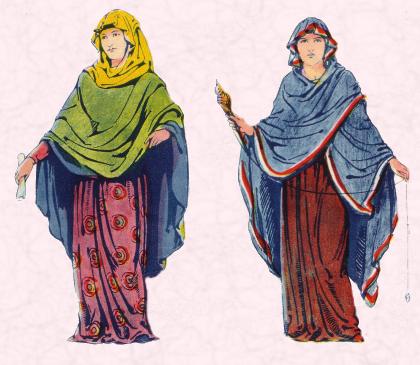
Now, let's look at this Swedish lady.  Her husband is pretty boring but she is... wait..  she is rocking a SKIRT AND BLOUSE!

"Trendsetting in the Bronze Age"

This Celtic lady has one on, too!!

Wait!  What is that??!


This is a skirt and blouse in case you forgot what they look like.
 I know, it's been all chitons and tunics lately..
 This is partially the reason why places like Sweden and Norway have national historical clothing which looks like this:
Though it doesn't explain the hats.

 Anyway, as is normal with tribal societies, local trends and technologies tend to determine what folks wear.  Also, just trying to survive determined what you wore since making fabric takes a LONG time.  Generally speaking, though, not a whole lot changed because everyone was trying to figure out how to live by eating rocks and sticks for dinner.   Men did start to wear their skirts longer

Probably cause their pants were terrible


and those glamor queens in Bysantium kept rocking the fashion world.
"Don't bother bringing the heat 'cause it's already been BROUGHT!"

Now, for your test!

https://docs.google.com/spreadsheet/viewform?formkey=dFA3Z2xGX1VHLXpqZGs1c0lWaW9XMlE6MQ#gid=0