Jan 20, 2014

#20 - The Gilded Age/Belle Epoque

Hi,
I know it's been a long time since the last class.  This happened because
1) I got a new job where I had to learn lots of stuff really quickly and
2) I HATE the Victorians.

In fact, I hate the Victorians so much that I did almost everything on the list below to avoid talking about them.


Believe me when I say I WISHED I could have been a Delagator!

Yeah, anyway, six months (and Christmas) later, I realized (today) that I could just skip them!  Move on and pretend it never happened!  Yay!

Yeah, I get it.  Not an impressive excuse.
So, by way of apology, let's start with the interesting stuff... underwear!

If you recall, the Industrial Revolution was in full swing and neat machine-made corsets let everyone compress their inards into facinating new shapes.   Well, 1860 is around the time all this industry really kicked into high-gear.  According to Wikipedia, "From 1860 to 1890, 500,000 patents were issued for new inventions—over ten times the number issued in the previous seventy years."

All sorts of amazing facinating stuff was being made and invented, and more importantly, implemented into the lives of everyone.  By the end of the century folks had electricity in their homes for the first time ever.  There wasn't a lot of war going on (well, in Europe.  There was that Civil War here at home, ) and so there was time and resources and faith in the future and technology.   In fact, the years 1870 - 1814 have their own name.   They are called Belle Epoque in France and The Gilded Age in the U.S.

 [As a side-note, the phrase The Gilded Age is actually the title of a book written by Mark Twain and Charles Dudly Warner.  You will not be surprised to learn that it is satirical.  Twain called it a gilded age because there was all sorts of poverty and suffering by immigrants and folks in the South that was happening and no one paid attention.  "Gilding" is when you put gold leaf over something dark and cheap to make it look pretty.  The phrase immediately took off.]

In Britan the Edwardian era is roughly in this timeframe though Victoria didn't die till almost 1900.  These years are exciting because this is when we got the Eiffel Tower, Art Noveau,  Impressionist and Expressionist painting, railroads and telephones, automobiles and motorcycles, airplanes, and the beginning of things like women's suffrage (go Susan B!) and temperance movements.  We also got Impressionist music and dudes like Chopin and Debussy.   Since I like Debussy, here is a sample:


Another important thing is the world-wide expansion of trade, and more specifically, trade with Japan, which had been closed to the Western world for 200 years.  Japan opened in 1850 and soon the influence of it's art (ceramics, wood block prints, painted screens), furniture, and fashions (specifically textiles and the shape of kimono) began to leech into Western thought.  This process has been labeled Japonism and it's the reason Toulouse-Lautrec made posters which looked like this:


instead of this:


Though, there may have been other reasons.

He may have been slightly obsessed.  He was also pretty silly.
ANYWAY, what does this have to do with underwear?   Well, let's talk about those corset things.

"Remember me?"
There was a lot of discussion by the 1860's about corsets.  It is actually called the Corset Controversy or sometimes "the corset question."  There were all sorts of arguments for and against tight-laced corsets
With exciting infographics!  These armless skeleton ladies are totally gonna FIGHT!
but women kept wearing them all the same.   Really, it was a no-win situation for women.   Everyone, from preachers to fashion magazines told them that tight-laced corsets were terrible for you and made you vain (and therefore morally corrupt) but then you were told that to be acceptable you had to look like this:
Clearly, this is pure evil.

"Are you wearing  corset?" "Who me? No!  I totally just look like this normally!
By the way, what two-year old did you steal your feet from? So tiny!"
There was literally no way to look like a semi-normal human woman and not wear a corset.  (Today's equvalent would be to simply refuse to wear any form of bra.  Ever.  At all.  Go ahead and imagine that.  Then know that people would say things, though not necessarily to your face.)

 So tight-lacing continued and skirt silouttes shifted from bell-shaped


to sort-of pulled back


to not as much stuff to pull back


This is the dress one would wear to the beach.  No, I'm totally not kidding.
Try looking at tide pools in this get-up. 

to just really stinking tight.


Though still pretty because I love plaid!
Anyway, with all this, corsets got longer in the torso, covering the hip.   At the time, the front of corsets were equipped with a "spoon busk",  which was made of metal.  The busk was still pretty new in the development of corsets.  It is metal fastenings on the front of the corset that let you put it on yourself rather than pulling it over your head and making someone else lace you tight. The spoon busk made a curved shape that controled the front of the corset, bringing your waist in and then making sure all your insides didn't pooch out below it in an "unattractive" manner.


Well, well-intentioned corset engineers designed the straight-busk corset, or the "Health Corset."  The idea was, if they got rid of the spoon shape, it would be healthier and better for the wearer.  Sounds awesome, right?

Wrong
Women took the health corset and tight-laced that sucker, which gave them the S-curve posture.  This, to me, looks really dumb, and worse for you than the previous corseting.

Do you mean I get to be smug and rude to folks who don't look like me? This is some compelling advertising! 

All your friends are doing it!

And that one girl looks AMAZING!

What's NOT super stylish about having to carry a walking stick with you so you don't fall over?
(..though holding yourselfl up with furniture works, too.)
So, straight busk corsets and S-curves are now the thing, no matter what anyone says about it.  There are a couple interesting things about this, though.  First is the extreme emphasis on the backside.  This bottoms-out posture started with bustles but now is supposed to be the woman's actual bum.  This back-curving extreme position reminds me of something we see these days.  What is it.. hmm... let me think...


Oh yeah!  Now I remember!  It's the same weird pose that women do when they are being decorative objects in front of stuff folks are trying to sell!  Both of these models are holding on to the motorcycle just to stay upright, (though the female is better at it.  Perhaps if the gentleman had worn higher heels?) just like the lady in the picture before!  So hyper-sexualization is what tight-laced S-curve straight-busk corsets brought to fashion.  And, really, you shouldn't be surprised because reproduction and decorative capabilities were a woman's primary role.  In fact, menopause was seen as a mental defect and a sign of moral degredation at the time, never mind it's just a normal biological process. I mean, who WOULDN'T want to be 85 years old and pregnant? (Did I mention that I hate Victorians?  'Cause I really really do.)

The other odd thing is the mono-bosom, or the pidgeon-breast, or, basically, the really weird way everyone's chest looked.

Super weird.
I really have done some research over the past 6 months and I haven't been able to find one solid reason for why this look happened.  The closest thing I could suss out was about Prince Edward's sexual preferences.  He was a wild partier (you would be, too, if your mom was Queen Victoria) and he liked heavy older women.

"Hi!  I'm an Edwardian super-hottie!"
So, heavy large full matronly breasts were preferred.  None of that young-looking stuff, please.  No thank you.  If you don't look like you've had six kids, we don't want ya.

"Done!"
The look also didn't want anyone even thinking that there were two actual breasts.  Yuck.  No, better to have them all compressed and pushed down low to the middle, right above your tiny freakish waist.  That's WAY hotter!

Is that a mangled Buzz Lightyear doll on the step in front of her?  What sort of time-traveling freak is she??

Obviously, actual people aren't shaped this way, or, at least a small percentage of them are.  This heavy look is particularlly tricky for young women to achieve.  So, naturally, solutions were found. One could put ruffles on your dress


or lace


or LOTS of lace

Totally works!

or lots of beaded fringe


or beaded anything, really.


For everyday wear you could just pouf your shirt


though for the tragically perky, there were sterner measures.


Apparently, if all else failed, you could also go with just super creepy.


Anyway, that's underwear up to about 1900's.  Weird, huh?

ALERT!
I apologize but there has been a change.  It seems I totally missed the fact that the pidgeon breasted shape was THE ideal shape for Victorian men in the 1840's.  In a time when women were wanting to vote and ride bicycles in public, the assumption of a masculine but outdated men's sillouhette is not surprising.  Sorry for the incorrect guess.

Well, let's get back to Japan.   We were getting influenced by them artistically, and they were influenced by us as well.  Traditionally, Japanese women's kimono was pretty unconcerned with the bust of their dresses.


"Whew, it's hot today!"
"Seriously.  I'm melting here."
At the time, everyone could go topless, including women because, well, why not?  Whatever.  However, when the Western women started showing up the Japanese women saw their dresses and thought "They're wearing a dress, I am wearing  dress, what's the difference?"

"Well, besides our totally awesome shoes..."
What happened was the bustlines of kimono got a little pouf over the obi, just so they could look pidgeon-breasted like the white ladies.  This look continues to this day.


Anyway, I'm mostly done.   But, before I go, you might be asking, "What did men wear for 50 years?"

"Oh, you know.  Man stuff..."

"More specifically, AWESOME man stuff, yo!"

"My hat is the ONLY hat allowed at formal events."

"We're cowboys and don't go in much for formal events.  However Ralph here
does really like his doll."


"I'm Prince Albert and I approve all this man stuff... including the doll. I am also wearing a corset."
"We just got married and we are really happy.  For reals."

"I don't know what it is, honey.  The doctor just said it was 'mouse-clicker finger'.
What do mice have to do with anything?"
If you will notice, the dudes in the bottom two photographs are wearing clothing that looks modern. This is because only tiny details have changed in menswear for a long time.  More on that next time.  For now, though, here's a test!

https://docs.google.com/forms/d/1AsWQvGADlTU4pozCU3slA_xyATeD8yKcLp4uXhUIAWg/viewform

Jul 30, 2013

#19 - It's Time for "The Talk"...


There comes a time in every child's life when it is appropriate (and the child is mature enough) to sit down and have an open, honest, frank discussion.

That's right.  I am going to talk about:

Industrialization

Colonialism or Imperialism

and

Nationalism

I know, I know, it's awkward and uncomfortable for everyone and if you have questions you should totally take them to your parents. But I feel it's important to talk about these ideas, especially since they came of age during the Victorian Era and they are still impacting us today. The Victorian Era, or the years 1837 to 1901, is my least favorite time period in fashion.  Ever.  I would rather write two more lectures on codpieces than explain the Victorians because I feel they were tacky stratified know-it-alls.   However, there really isn't anything (good) to say about codpieces and a LOT happened in the 64 years Vicky reigned so I'd better just knuckle down and get to it.

Also, the fact that you might have been uncomfortable because you thought I was going to talk about sex is another little cultural gift from the Victorians.

"You're welcome."

Now, you might have been reluctant to click the hyperlinks above and read about these things.  It would behoove you to do that so let's pretend you actually did and now go to a video about the Industrial Revolution (because I'm fairly sure you didn't read anything.)


That wasn't so bad, right?  Thanks to cheap coal, now the British have a massive technological edge on the rest of the world.   Let's see what they do with it:


Yes, it's a bit silly.  British Imperialism, or colonialism was mostly driven by the East India Company's desire for trade (i.e. money) and for the demand for awesome stuff in England (i.e. sugar, cotton, tea, tobacco) to buy with their high wages.  Slavery was abolished in England in 1772 (BEFORE the U.S. declared independance in 1776) but for all those other countries who have slaves and make/have stuff we totally want, it's totally okay, right?  I mean it's not like they are BRITISH, right?  England fought three civil wars and killed a monarch over the right to Liberty so they are big fans of the concept but when you are talking about tea... or sugar... (or diamonds or cotton or gold or basically anything anywhere that anyone wants) well, the ethics go all squishy.

Which leads us to nationalism.


I know, that seems like we are getting ahead of ourselves and it's NOT about England.  I mainly picked that video because it is less than two minutes long and I thought yall might be getting tired of watching videos.  I also didn't pick this video:


because I didn't want to put TWO videos in by the Crash Course guys.  (However, if you do watch it, you can think about his argument for public school at the end of the video and I will provide space in the test for you to leave your ideas/questions/concerns.)

Now, how does nationalism relate to slavery, Susan?   Well, if nationalism is pride in a group of people who are like me and who live in the same place and sets up cultural and social walls around this idea, then people who are NOT like me, or who live in a DIFFERENT place, aren't on my "team", right?
"You can totally join MY team, sailor!"
Up until this time in history, the world was pretty feudal.  There were dukes and lords and princes and daimyo and sheiks and everything that wasn't farmland was kind of a city-state.  Sure, we had Kings to be loyal to (or to kill) but most folks lived in small communities and didn't think of themselves as "British" or "French" or "American" but as a Londoner or a Corsican or a Virginian.  Nationalism made the Us vs Them mentality a MUCH bigger thing.  And it is hard to care a lot about a bunch of "Them" when you only know a lot of "Us" and all the "Us"-es are saying it's a great idea to go fight a war with China because they want us to actually pay for our tea.  Or start giving support and munitions to guys who want to overthrow the local leaders in India so you can make some serious money when everything gets chaotic.

Why am I telling you this?  I bring it up because it is still happening today.  Our industrialization is accelerating and now we have amazing stuff like smartphones and light up sneakers.
I've been blinded by Science!!

Every time you buy a shirt made in Bangladesh, you are contributing to what is essentially the enslavement of a group of "Thems" for a cheap product.

I totally got a killer deal on that shirt, though...

And whenever you ask someone a quiet question about how our country works and they immediately yell "WHY DO YOU HATE AMERICA???" then you are dealing with nationalism.

Because the best liberty is the freedom from critical thought and honest dialog.
That's gotta be in the 270th amendment or something...
Now let's look at some clothes.

Or, more accurately, let's look at some sillouettes of clothing.   I found this awesome graphic on the Pinterest.   In case you were wondering, there are a LOT of people on Pinterest who love to collect photos of Victorian dresses.   Some of them are historical re-enactors and the photographs are for research purposes.  Others collect them because they think the clothing of this era is just really really pretty.
This dress is somehow made out of bathmat ruffles.  Their argument is invalid.
But, I digress.  The awesome thing about the graphic above, (not the bath mat dress), is that it shows (among other things) the difference in skirt volume between 1847 and 1852.  What happened between those years is the crinoline.
 Prior to this time, when a lady wanted an enormous skirt, she wore lots and lots of startched ruffled skirts made out of horsehair & linen.
"Albert, I know it's just Buckinham palace, but would you be a dear and pick up all the dead animals off the carpet?
I'm wearing ten petticoats and am liable to trip over them (or the child) and break our royal neck."
It was bulky and heavy and only the wealthy could afford to have super puffy skirts.

Well, in America there was an industrial revolution going on and people were inventing things all the time.  (One new invention was the idea that "home" and "work" were two totally separate places.  Before this time work was the farm outside your door or the bakery you lived above or whatever.  Only with the development of factories and mercantilsm could this idea evolve.  Victorian houses got darker and more closed-in over time, with middle- and upper-class women hanging out hidden in a house all day while the men left for "work".  Of course, their tight-laced corsets and ten petticoats made it hard to do anything else.)

Though they totally made time for covering their entire house with as
much junk as they could possibly find.

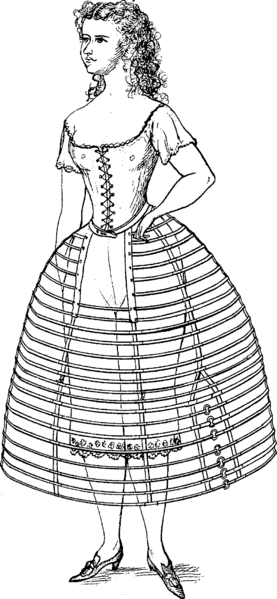
Anyway, in 1846 a David Hough, Jr patented the hoop skirt.  In 1858 a W.S. Thompson patented the cage crinoline that had fabric tapes suspending metal hoops.

This was pretty awesome because the crinoline was light, flexable, easy to walk in, mass-produced, and everyone could have the enormous puffy skirt look without having a million dollars.  Naturally the upper classes were scornful of them but the Americans LOVED them.
They did have some downsides though.  Because they were super light they tended to swing around in the breeze and fly up.  Women actually had to start wearing long drawers (remember, underwear wasn't a popular thing.  It was considered to be too "masculine") because it was very probable that you could flash the world.  Also, sitting was kind of a trick and if you weren't careful the whole thing would flip or puff up and look silly.
Naturally inventors got right on that.

Anyway, the styles got really ridiculously large for the extremely fashionable


but they didn't last because they were silly and because ANYONE could have an enormous skirt.  The cool thing was to get new crinolines in new cool shapes.


Let's go back to our sillouette graphic.
Look at the shapes and see if you can trace when these new crinolines became popular.

This leads me to another random point.  Sandy sent me a link to a dressmakers book from 1921.  Here are a few pages from this book that I want you to see.


This is the simplest explanation I have ever seen of how one studies fashion.  So, let's try it.  Look at just the waistlines of the below image.  Then the skirts.  Then the bustlines.
Notice anything?  It's cool, huh?  And you are probably wondering what's up with 1902 there.  Well, that is Edwardian so that will be covered next time but good job spotting it.  The whole system of looking at one thing, finding similarities, moving on to other things, then classifying everything you have seen is an excellent one.  I'm pretty sure it would be a useful tool in assessing all kinds of stuff, not just clothing.  However, it's pretty great for fashion, too.

So, what else was new and exciting in this time?  Photography!  Queen Victoria was the first monarch to ever be photographed.  We are used to formal royal photographs

but it wasn't long until photographers managed to catch images which were little slices of life.
I'm sure Victoria hated this photo
Photography was also developed just in time to document the American Civil War.  Yup, we are there already but you should have guessed that from the southern belle skirts.   Let's look at some photographs (of people, not of the war.)

Mary Todd Lincoln
Mrs. U.S. Grant


Mrs William Brace and daughter 

Seamstress posing with her livelihood

Look at the amazing use of pin tucks and fabric orienting on this dress.
She has done an amazing job with that simple striped cotton.

siblings

Union officer

Some women of Fredricksburg

Family portrait (Brother is looking SASSY!)

EVERYONE wore a corset.  Victorians thought
you would become "deformed" if you didn't


"MORE photos??"


Just this one because she's so lovely. :)
Ah! I could look at photos all day!

Okay. ONE more because they're just so CUTE!
This posting is too long already and I haven't even started talking about corsets or dyes or Victorian culture (not that I actually want to).   So, for more photos of people and dresses, how about you just go HERE.  That is the page where I keep everything I think I might possibly use for this class but end up only using 10% of it. It's super cool so feel free to browse through because I can't possibly post it all, even though totally I want to.

Alright, I'm going to have to stop today in the mid-1860's.  So, let's talk about color.  In 1860 everyone is in the Second Industrial Revolution, which means steel (and railroads) and all sorts of new dyes. The Victorians LOVED these new colors.  They were so excited about the new arsnic green

This color
that they painted their walls with it.  Of course, it leaked arsenic into the air and so they were slowly poisioning themselves but it looked AMAZING so whatever.

Let's look at more intense colors.

I don't even know what to call these two colors.


But this is totally arsenic green


These are "promenade clothes" which means you'd slip this on when you went for a walk.
I'm guessing the risk of being run down by a carriage is pretty low in colors this intense.


The tartan evening gown above is in acid green and cobalt blue and it's one of the few things I love about the 1860's.  Plaid dresses.  I don't know why I like them so much but they are all pretty great, and EVERYONE had one.


Even pregnant ladies (this is a maternity dress.)

"Those sure are some snappy-looking dresses!"
Basically, after the pastels of the Empire period, loud colors and LOTS of fussy ornamentation was considered totally awesome.
even when it got a little out of control.
Fringe, lots of it, was also a new and exciting thing during this time.  It normally was made from the strings at the edges of loomed cloth but with new manufacturing techniques, this incredibly time-/labor-intensive item could be purchased and stitched everywhere!  Whoo-hoo!

I think it makes everyone look like they are wearing a curtain.

Alright, corsets next time and maybe I'll think about talking about men.  Here's your test:

https://docs.google.com/forms/d/1oWJglFGpAUoXyU1XS8nPNfoPCpcJQzHIp6DM3AB6KMU/viewform